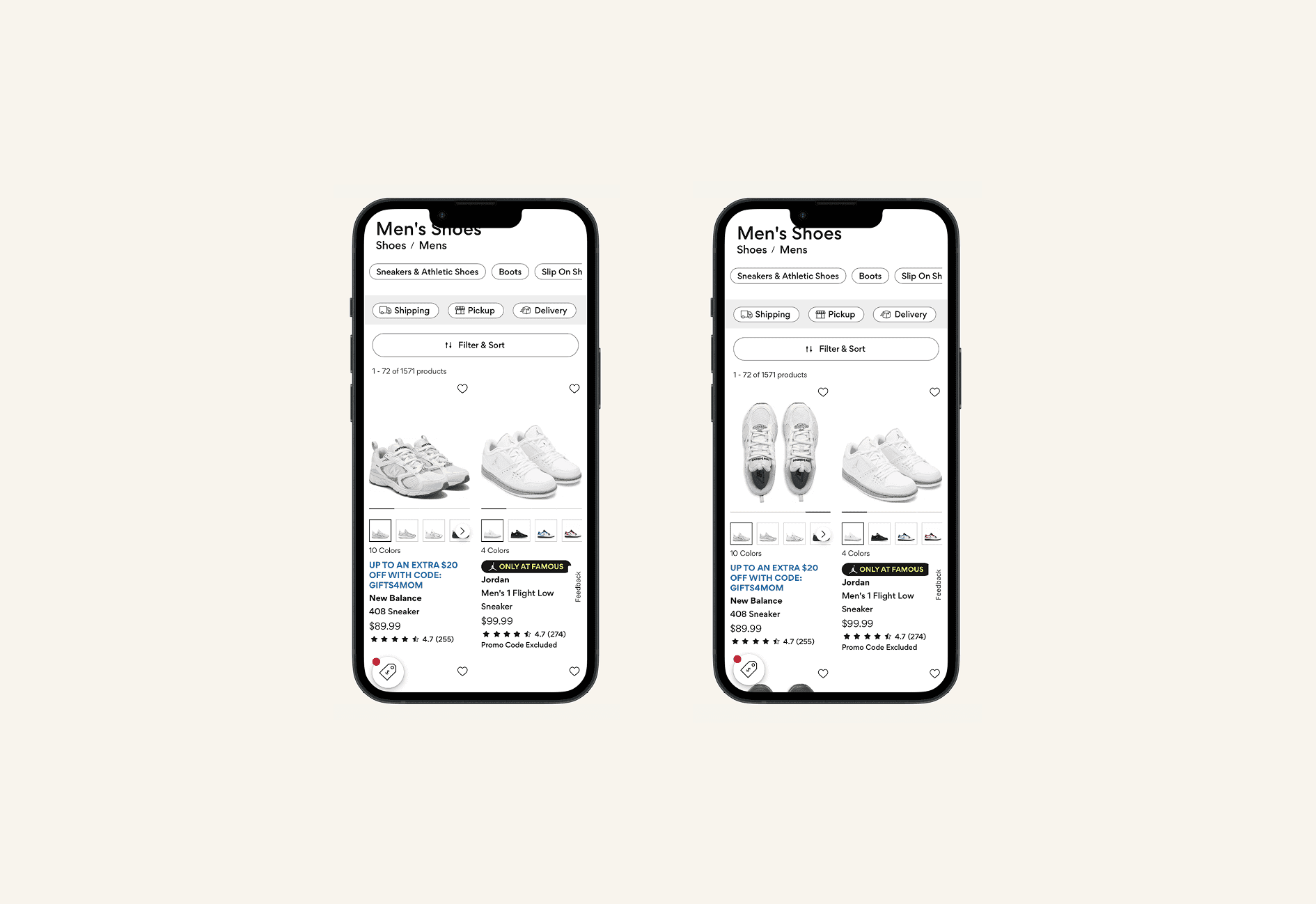
This project set out to answer a core question: would allowing customers to swipe through multiple product images directly on the Product Listing Page (PLP) reduce friction and improve downstream Add-to-Cart performance, or would the interaction go unnoticed? To explore this, I led a series of five rounds of usability testing across 30+ participants, iteratively refining both the prototype and the study design based on each round's findings.
Early rounds revealed a consistent and telling pattern — while a majority of participants eventually swiped through images, almost none did so naturally or on their first attempt. Most tapped the product expecting to be taken to the PDP, and swipe behavior was largely discovered by accident or prompted by study questions. Despite low initial discoverability, participants who did find the feature responded with genuine enthusiasm, using words like "excellent," "cool," and "efficient," and rating it 5/5 for meeting their needs once discovered.
Each round informed a targeted design improvement. Round 1 and 2 findings led to cleaner task wording and making all products interactive. Round 3 introduced a brief animation to signal swipeability, and Rounds 4 and 5 tested the impact of a 6-second animation alone (V.4) versus an indicator bar combined with animation (V.5). V.5 yielded a higher ease-of-use average (4.3 vs. 3.8) and 100% swipe completion, compared to 83% in V.4 — a meaningful improvement, though discoverability remained a challenge across both versions.
Based on the full body of research, V.5 — the indicator bar paired with the animation — was recommended as the design to move forward with. The findings make clear that while the swipe feature delivers real value and satisfaction once known, it requires intentional onboarding to become intuitive. The recommendation is to proceed with V.5 as a foundation for training customers on this new interaction pattern.